|
Charleston South Carolina Historical Homes and
Buildings |
|
|
|
|
|

Drayton Hall 3380 Ashley River Road -
Charleston, SC 843-769-2600 Completed in 1742, the
historic plantation house stands majestically on a
630-acre site and is one of the finest examples of
Georgian-Palladian architecture in America. Through
seven generations of Drayton family ownership, the
plantation house has remained in nearly original
condition and offers an opportunity to experience
history, to imagine the people—white and black—who lived
and worked in a far different time.
 Magnolia Plantation and Its
Gardens Listed in the
National Register of Historic Places by the U. S.
Department of the Interior, stately Magnolia Plantation
has, for over three centuries, been the original
ancestral home of the Drayton family, whose many sons
have played important roles throughout American history.
It is believed that no other plantation in South
Carolina is still under original family ownership from
that early date, thirteen generations of the
present-owning family having enjoyed
it.

Joseph Manigault
House Rice was South
Carolina's economic base in the early 19th century.
Profits from growing and trading it made possible the
buildings which comprise Charleston's noted
architectural heritage. Among the most elegant of these
is The Charleston Museum's Joseph Manigault House, a
National Historic Landmark, located in downtown
Charleston close to the Museum and the City Visitor
Center.
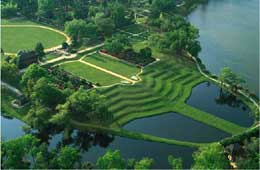
Middleton Place Ashley River Rd. (Hwy 61), 14 miles NW of
Charleston, SC A National Historic Landmark and a
carefully preserved 18th-century plantation that has
survived revolution, Civil War, and earthquake. It was
the home of four important generations of Middletons,
beginning with Henry Middleton, President of the First
Continental Congress; Arthur, a signer of the
Declaration of Independence; Henry, Governor of South
Carolina and an American Minister to Russia; and
Williams, a signer of the Ordinance of Secession. Tour
the Gardens, the House Museum, and the Plantation
Stableyards.
Aiken
Rhett House 48 Elizabeth
Street - Charleston, SC Few houses in the American
South provide a more complete document of antebellum
life than the Aiken-Rhett House. Built by merchant John
Robinson in 1818 and greatly expanded and redecorated by
Governor and Mrs. William Aiken Jr. in the 1830s and
1850s, the property has survived virtually unaltered
since 1858.
Calhoun
Mansion 14-16 Meeting
Street - Charleston, SC The story of the Calhoun
Mansion actually starts almost a century before it was
built, when the ground on which George Walton Williams
would build his home was hallowed in the tradition of
optimistic patriotism. The land that would later become
14-16 Meeting Street in downtown Charleston, South
Carolina, was originally part of the plot of the Lowndes
house, the property of Governor Charles Pinckney, who
hosted George Washington three times in May of
1791.
Charleston Museum, The 360 Meeting Street - Charleston,
SC 843-722-2996 America's First Museum, founded in
1773. Its mission is to preserve and interpret the
cultural and natural history of Charleston and the South
Carolina Lowcountry. We invite you to explore this rich,
varied history at the Museum and its two National
Historic Landmark houses. All are located downtown, in
America's Most Historic
City.
|
Tour
Charleston SC real estate. Homes For Sale - Historic Beach
Waterfront
Lots
Charleston
SC Real Estate Homes Online
Financing
Issues Schools Mortgages
Search the MLS
Charleston Utilities & Info
Schedule Showing
Online Visitors Guide ·
Historic Charleston Homes
Wild Dunes Kiawah Island & Edisto Beach
real estate
Charleston SC Real Estate
Discover all that the greater
Charleston real estate market has to offer - contact Eve
Olasov - Charleston real estate agent and Charleston Realtor
to provide customized help in your search for historic,
waterfront, beach, or homes in golf course communities in
Charleston, Mount Pleasant, Daniel Island and more. Search homes
for sale.
Eve Olasov, Realtor
111 East Bay Street
Charleston, SC 29401
Toll Free 1.866.957.9100 |
|
TRAFFIC CAMS and
REPORTS SCDOT Interstate Traffic
Cams
Area
Municipalities Charleston Charleston
County North
Charleston Mt.
Pleasant Isle of
Palms Kiawah
Island Goose Creek
Convention and Visitors Bureau
SCPRT
Charleston Virtual Tour #3
(low bandwith) Charleston Metro
Chamber of Commerce
South Carolina
Nature-Based Tourism Association South Carolina
Department of Natural Resources
South
Carolina National Heritage Corridor-Region
4
EVENTS Charleston
Convention & Visitors Bureau Official
Events Calendar City of Charleston Events
Calendar
MUSEUMS &
HISTORY Charleston Museum - America's first
museum Drayton Hall - A National Trust
Historic Site Fort Sumter and Walking
Tour Charleston
County Library - Historic
District Patriots Point
Naval & Maritime Museum Old Santee
Canal Park The South Carolina
Historical Society Genealogical and
historical resources The Avery
Research Center for African American
History and Culture Civil
War at Charleston
MISCELLANEOUS
Charleston Convention
Center
Charleston County
Parks South Carolina
Aquarium The H. L.
Hunley official web site
Citadel Museum,
The The Citadel Museum
represents the history of The Military College of South
Carolina from its founding in 1842 to the present.
Arranged chronologically, the permanent exhibits feature
the military, academic, athletic and social aspects of
cadet life. There are over three hundred collections in
the Archives which pertain to the history of The Citadel
or have military significance. The time span of the
collections is from 1842 to the present. Holdings
include personal papers, letters, diaries, reports,
minutes, speeches, Citadel publications. Visual images
include photographs, postcards, engravings, films and
videotapes.
City Hall Gallery,
The Charleston's City
Hall building was constructed between 1800 and 1804 in
the Adamesque style. In 1800 the City Council conveyed
this parcel to the Federal government for the purpose of
erecting "an elegant building" that would serve as a
branch of The First Bank of the United States.
Charleston's branch was one of eight in the country,
serving as the Office of Discount and
Deposit.
College of Charleston Founded in 1770 and chartered in 1785,
the College of Charleston is the oldest institution of
higher education in the state of South Carolina and the
thirteenth oldest in the United States. The founders of
the College, who sought "to encourage and institute
youth in the several branches of liberal education,"
included three signers of the Declaration of
Independence and three fathers of the United States
Constitution.
Confederate Museum,
The 188 Meeting Street -
Charleston, SC
Dock Street Theatre,
The An essential part of
the streetscape of Church Street, the Dock Street
Theatre is Charleston's last surviving hotel from the
antebellum period. The silhouette of its wrought iron
balcony against the spire of St. Philip's church may be
the single most photographed spot in the city. The main
portion of the building was constructed around 1809 as
Planter's Hotel. The hotel was built by Alexander Calder
and his wife, who did so by renovating several
pre-existing buildings at the site. The main entrance
may not have been built until 1855 by J.W.
Gamble.
Edmondston-Alston
House 4300 Ashley River
Road - Charleston, SC 843-556-6020 The stately
Edmondston-Alston House was built in 1825 on
Charleston's High Battery and is one of the city's most
splendid dwellings. A witness to many dramatic events in
Charleston's history, the Edmondston-Alston House is a
classic example of the city's changing and sophisticated
taste in architecture and decorative arts. Guided tours
of the house give visitors an insight into the lifestyle
of merchant Charles Edmondston, who first built the
house in 1825, and Georgetown County rice planter
Charles Alston, who later bought the house in
1838.
Heyward-Washington
House "Charleston's
Revolutionary War House" Located in the downtown
Historic District, within the area of the original
walled city, this brick double house was built in 1772
by rice planter Daniel Heyward as a town-house for his
son, Thomas Heyward, Jr. The City rented it for George
Washington's use during the President's week-long
Charleston stay, in May 1791, and it has traditionally
been called the "Heyward-Washington House. Thomas
Heyward, Jr. (1746-1809) was a patriot leader, signer of
the Declaration of Independence, and artillery officer
with the South Carolina militia during the American
Revolution.
The Nathaniel Russell House Since
the early 1800s, visitors have admired the townhouse of
Nathaniel and Sarah Russell, completed in 1808. Set amid
spacious gardens, the mansion is recognized as one of
America's most important neoclassical dwellings. The
graceful interiors with elaborate plasterwork
ornamentation, geometrically shaped rooms and a
magnificent free-flying staircase are among the most
exuberant ever created in early America. Furnished with
period antiques and works of art, many of Charleston
origin, the house evokes the gracious lifestyle of the
city's merchant elite.
Old Exchange and Provost
Dungeon Few
buildings reflect Charleston, South Carolina's early
history as effectively as the Old Exchange Building and
Provost Dungeon. Considered to be one of the three most
historically significant Colonial buildings in the
United States, the Old Exhange Building is a "must see"
when visiting Charleston.
|
| |